Christopher O. Fedde
PORTFOLIO
| 2013 - Truss Studio |
2008 - KeyTruss | 2007 - Briffits Application Platform |
| 2007 - RapidLog Client | 2004 - OmniExplorer | 2003 - OmniBrowser |
|
|
|
Truss Studio (2013-2023)
[BACK TO TOP]An application suite (project management, 3D layout, 2D truss design) used by engineers and truss manufacturers for design and analysis of roof and floor trusses.

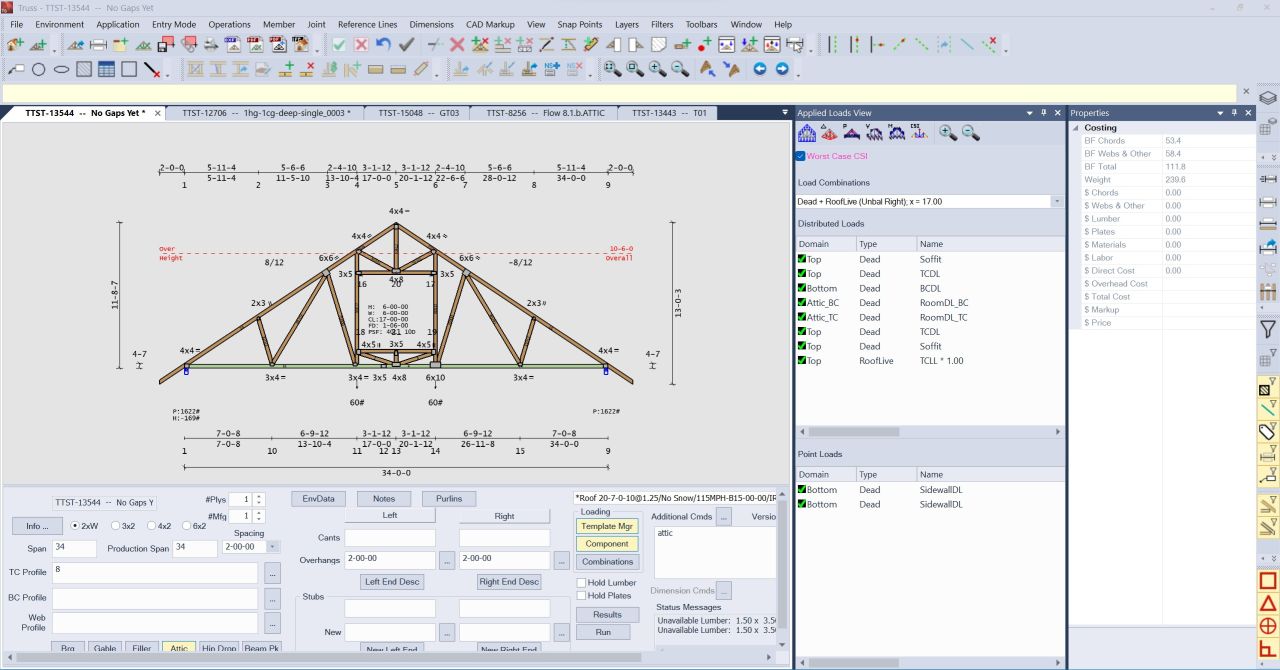


Details: Windows 11, Microsoft Visual Studio 2022, C++, MFC, WPF
Timeframe: 2013-2023
Company: Simpson Strong-Tie, Pleasanton, California USA (working from their Boulder, Colorado USA branch)
See: Simpson Strong-Tie Component Solutions® Truss Studio™
Involvement:
- User Interface Design and Coding.
- Software coding -- team size fluctuated but was generally five to ten devs on project team.
- Code maintenance, new feature development and bug fixes of a 1 million+ lines of code legacy application.
- Work carried out in an Agile team environment (test-driven development, scrum, 2-week iterations).
- Worked closely with a staff of professional engineers to develop algorithms and to check failure-mode and building-code compliance.
KeyTruss (2008 - 2013)
[BACK TO TOP]An application used by engineers and truss manufacturers for design and analysis of roof and floor trusses.


Details: Windows 7, Microsoft Visual Studio 12, C++, MFC
Timeframe: 2008-2013
Company: Keymark Enterprises, Boulder, Colorado USA
See: Keymark Enterprises - “The KeyTruss Software" (YouTube vid. I make a cameo at 22 secs in. Blond guy on the right)
Involvement:
- User Interface Design and Coding
- Software coding -- one of five programmers on project team.
- Code maintenance and bug fixes of a 1 million+ lines of code legacy application.
- New feature
development: Stacked Chords, Partial Top Chords, Hanger
Selector
- Work carried out in an Agile team environment (test-driven development, scrum, 2-week iterations)
- Worked closely with a staff of professional engineers to develop algorithms and to check failure-mode and building-code compliance.
[BACK TO TOP]
Briffits Application Platform (2007)
[BACK TO TOP]
Developed an application framework used for writing and
deploying small stand-alone applications (mini-apps) for the
PocketPC platform. Worked on as a speculative side project
in 2006 and 2007 (non-paid). Code was eventually released
as a finished product,
although this occurred after I had left the project (the
application platform was basically completed at that point...
all of the sample screen captures shown below were fully
functional by that time).

Details:
Windows CE 2003, Microsoft Embedded Visual C++ (eVC
4.0), PocketPC platform
Timeframe: 2006-2008
Company: Briffits, Loveland,
Colorado USA
Involvement:
- User Interface Design and Coding
- Software coding -- one of two programmers on project
- Invented xml-based file format for formal specification of the resources needed for each mini-app and how those resources should be composited together on the screen. Clicking on the individual screen captures shown below will display the xml files responsible for each mini-app. The first shown screen capture (with the "Briffits" text in yellow across the top) was a "Demo Chooser" app that could load up any of the other demo apps.
- Implemented a Lua Scripting Engine into the application platform to allow creation of "behaviors" by non-programmers. For example, the rotation of the clock hands is synched with the operating system via a Lua function call. As another example, all of the calculator state and button callbacks are implemented via Lua function calls.
- Implemented graphics pipeline for placement and compositing of screen elements in OpenGL (early prototype) and in GDI.
- Implemented use of a third-party text rendering library for high-quality antialiased text (AGG).


[BACK TO TOP]
RapidLog Client (2007)
[BACK TO TOP]An application used by over-the-road truckers for logging of driving hours for compliance with Federal regulations.


Details: Windows 2000, Microsoft .NET (Visual C#)
Timeframe: 2006-2008
Company: Eclipse Software Systems, Greeley, Colorado USA
See: www.rapidlog.com
Involvement:
- User Interface Design and Coding
- Software coding -- one of four programmers on project
- Development occurred in an aggressive Agile environment: TDD (test-driven development, all functionality and all functions fully tested, all tests run upon every checkin), XP (eXtreme Programming, two developers sharing a screen and keyboard), two-week iterations (no big-up-front design, all tasks broken up into small pieces that can be accomplished in a single two-week period), daily scrums, etc.
- Developed interactive tool used for importing existing printed log sheets and "templatizing" them for use in the program.
[BACK TO TOP]
OmniExplorer
(2004)
[BACK TO TOP]
An application for designing and running interactive content
presentations on the OmniGlobe. Basically a
multimedia authoring tool, OmniExplorer is optimized for rapid
design and prototyping of presentation screens, using a "click
and drag" model for positioning of screen elements.
Completed presentations are saved out to disk in the 'Omni
Globe Presentation' (.ogp) format.

Details: Windows 2000,
Delphi, GLScene, GoldParser
Timeframe: 2002-2004
Company: ARC Science
Simulations, Loveland, Colorado USA
See: "Globoccess Digital Globes"
(Purchased ARC Science Simulations in 2022)
Involvement:
- User Interface
Design and Coding
- Design of
Application Architecture
- Software coding and
testing -- sole programmer on project
- Developed techniques
for real-time interaction (via trackball) with displayed globe
images
- Developed "OGP" file
format (a LALR Grammar) and parsing tools for importing and
exporting files of that format out to disk.
- Investigated,
specified and integrated support for various input devices
(trackballs, button devices, touchscreen)
- Wrote a successful
proposal to present the OmniGlobe in Siggraph 2003's "Emerging Technologies" showcase
- Development of "Demo" and "Prototype" presentations for use at trade shows and during customer visits


Touchscreen control image (on the left) and the corresponding
disc image (on the right) as it appears on the
computer screen when an OGP is activated in "RUN" mode.
This is usually done on a system running two
monitors in "span" mode, with the signal for one monitor split
off and sent to a remote touch display, and the
signal for the other monitor split off and sent to the
OmniGlobe projector. To see the OGP file for
this
particular presentation ("Planets and Moons") click here.
To download a video (.wmv format) of
OmniExplorer in action (1280x1024, 7 MB, approx 5 minutes)
click here.

The images below are from the interactive progam ARC ran on
the OmniGlobe at the ACM Siggraph Conference on Interactive
Graphics in 2003.


[BACK TO TOP]
OmniBrowse
(2003)
[BACK TO TOP]
What it is: A Browser application
for quickly setting up and interactively displaying content on
the OmniGlobe. Used in-house, at trade shows, and sent
to prospective customers.
Four
fullscreen display modes:
3D Virtual
Trackball ('grab' and rotate the globe with mouse cursor)
"OmniGlobe" Projection
(a flat disc image sent to OmniGlobe projector)
"DayGlobe"
Projection (a flat half-disc image sent to DayGlobe projector)
Mollweide
(an oval whole-earth projection)
Details: Windows 2000,
Delphi , GLScene
Timeframe: 2002-2003
Company: ARC Science
Simulations, Loveland, Colorado USA
Involvement:
- User Interface
Design
- Design of
Application Architecture
- Software coding and testing -- sole programmer on project


Z-Viewer
(2002)
[BACK TO TOP]
What it is: A small "Viewer"
application for displaying office layouts originally designed
in Z-Axis. Designed to be freely downloadable from the
Web.
Details: Windows 9X,
Windows 2K, Visual C++/MFC
Timeframe: 2002
Company: Computer Human
Interaction, LLC, Seattle, Washington USA
See current download page: "Herman Miller Z-Viewer"
(No longer officially supported by Herman Miller but still
available for download)
Involvement:
- User Interface
Design
- Design of
Application Architecture
- Software coding and
testing -- sole programmer on project through initial release
and first major dot release (1.1)
- Worked with Z-Axis development team to create a common "base support library" shared between Z-Axis and Z-Viewer


Z-Axis
for Windows (2001)
[BACK TO TOP]
What it is: A powerful design,
specification, and visualization tool developed for Herman
Miller, an office furniture manufacturer.
Details: Windows 9X,
Windows 2K, Visual C++/MFC
Timeframe: 2000 - 2001
Company: Computer Human
Interaction, LLC, Seattle, Washington USA
See
current download page: "Herman Miller Z-Axis"
(No longer officially supported by Herman Miller but software
suite still available for download)
Involvement:
- One of 12
programmers on team rewriting Z-Axis from scratch as a
Windows-native application
- Implemented 2D and
3D drawing pipelines
- Team Lead for
project integrating high quality texture maps into furniture
renderings
- Developed 2D picking
and "point over" routines
- Developed code for
exporting completed layouts to AutoCAD
- Developed code for exporting a completed office layout to an external viewer application "Z-Viewer"


Icon
Conversion Tool (2000)
[BACK TO TOP]
What it is: In-house tool for batch
converting older vector-based icon sets into corresponding
bitmap icons
Details: Windows 9X,
Windows 2K, Visual C++/MFC
Timeframe: 2000
Company: Computer Human
Interaction, LLC, Seattle, Washington USA
Involvement:
- User Interface
Design
- Design of
Application Architecture
- Software coding and
testing -- sole programmer on project
- Rapid application development: Project completed in four days from first meeting to final deliverable


CMTool
for Windows (2000)
[BACK TO TOP]
What it is: Windows port of in-house tool
for converting AutoCAD DXF files into parametrically-driven 3D
models
Details: Windows 9X,
Windows 2K, TGS OpenInventor, Visual C++/MFC
Timeframe: 1998 -2000
Company: Fedde Digital
Graphics, Inc. (while working under contract for Lembersky
Chi, Inc.)
An application used for converting AutoCAD DXF files into a
custom, parametrically-driven 3D model format. In this
format, 3D models have “Attachment Points” (seen as a trio of
RGB balls in the image below) where other models get attached,
dependant upon a query to a product database.
Additionally, 3D models in this format have associated “Growth
Regions” where the models may be stretched. In this way,
a single drawer 3D model designed at 20 inches width may be
used for rendering drawers at other widths (24, 28, 32) by
simply querying the product database to determine how much
“growth” the base model needs.
Involvement:
- User Interface
Design
- Design of
Application Architecture
- Software coding and
testing -- one of two programmers on porting project
- Maintenance of
makefiles, libraries, backups


CMTool
for Unix (1998)
[BACK TO TOP]
What it is: In-house tool for converting
AutoCAD DXF files into parametrically-driven 3D models
Details: SGI Irix, Motif,
OpenInventor , C++
Timeframe: 1996 - 1998
Company: Fedde Digital
Graphics, Inc. (while working under contract for Lembersky
Chi, Inc.)
An application used for converting AutoCAD DXF files into a
custom, parametrically-driven 3D model format. In this
format, 3D models have “Attachment Points” (seen as a trio of
RGB balls in the image below) where other models get attached,
dependant upon a query to a product database.
Additionally, 3D models in this format have associated “Growth
Regions” where the models may be stretched. In this way,
a single drawer 3D model designed at 20 inches width may be
used for rendering drawers at other widths (24, 28, 32) by
simply querying the product database to determine how much
“growth” the base model needs.
Involvement:
- User Interface
Design
- Design of
Application Architecture
- Software coding and
testing -- only programmer on project
- Maintenance of
makefiles, libraries, system administration and backups
- Training and support
of 2 AutoCAD modellers hired on to use software
- Totally rewrote Z-Axis drawing pipeline to take advantage of new parametrically-driven models


Anatomy
Browser/Viewer (1996)
[BACK TO TOP]
What it is: Anatomy Browser
developed to "Showcase" a University-based medical imaging
research project
Details:
SGI Irix/OpenInventor/Motif, C++
Timeframe: 1994 - 1996
Organization: Colorado State University, Fort
Collins, CO USA (Project: Glaxo Virtual Anatomy, funded by
Glaxo-Wellcome)
An interactive “Anatomy Browser” developed for the display of
3D anatomical models. All models used in the browser
were created using surface triangulation algorithms that were
also developed by Christopher Fedde.
This application was developed in 1994 and 1995 by Christopher
Fedde while working as a Research Associate at Colorado State
University with the “Glaxo Virtual Anatomy” (GVA)
project. This project created a complete set of human
anatomical models. In 1995 Christopher Fedde was hired
as an Independent Consultant by Glaxo Wellcome Pharmaceuticals
to take this browser and the model set on-the-road to eleven
medical trade shows around North America.
Involvement:
- User Interface
Design and Coding
- Design of
Application Architecture
- Software coding and
testing -- sole programmer working on this application
- Maintenance of
makefiles, libraries, system administration and backups
- Development of
output routines for dumping images to Quicktime animation
loops
- Development of
output routines for dumping images to high-resolution print
devices (typically 6000x6000 pixels)
- All anatomical models shown were created with the "Contour Editor/Surface Triangulator" immediately below


Contour
Editor/ Surface Triangulator (1996)
[BACK TO TOP]
What it is: In-house tool for
creating a 3D surface model based upon a set of stacked serial
sectioning contours
Details:
Hewlett-Packard HP-UX/Starbase.
Ported in 1995 to SGI Irix/OpenGL
Timeframe: 1994 - 1996
Organization: Colorado State University, Fort Collins Colorado USA
Project:
Glaxo Virtual Anatomy (GVA), funded through a two-year grant
by Glaxo-Wellcome Pharmaceuticals
PDF file showing one of the
"source" sectioning images and some of the final rendered 3D
models.
Project summary videos on YouTube: part
1, part
2 (that's me at 2:02), part 3,
part 4.
Involvement:
- The program was first developed as part of Christopher Fedde's Masters Thesis work while a Graduate Research Assistant at CSU between 1988 and 1990 and was revived and adapted for use by the Glaxo project in 1994/95
- User Interface
Design
- Design of
Application Architecture
- Software coding and
testing -- sole programmer working on this application
- Maintenance of
makefiles, libraries, system administration and backups
- Research and
Development of triangulation algorithms and surface smoothing
routines
- Development of file importers/exporters


Z-Axis
Classic (1992-93, 1996-97)
[BACK TO TOP]
What it is: A powerful office
configuration and sales tool developed for a large office
furniture manufacturer
Details:
SCO Xenix OS, written in "C", custom Matrox
graphics card
Ported in 1994 to SGI and Sun
Workstations
Ported in 1997 to Windows
Timeframe: 1992 - 1993, 1996 - 1997
Company: Lembersky Chi,
Incorporated
Involvement:
- Programming support
- Software coding and
testing
- Development of
system integration methodologies -- hardware installation,
testing, and burn-in, software installation
- Executed port from
SCO Xenix w/ Matrox graphics card to SGI Irix/IrisGL in 1994
- Completely revamped
the 2D and 3D drawing pipelines in 1996
- Provided key graphics programming support when Z-Axis Classic was ported to Windows in 1997


Color
Editor (1993)
[BACK TO TOP]
What it is: An in-house tool used
by graphic artists for color selection and for printer
calibration
Details:
SCO Xenix OS, written in "C", custom Matrox
graphics card (Later ported to SGI Irix)
Timeframe: 1992 - 1993
Company: Lembersky Chi,
Incorporated
Involvement:
- User Interface
Design
- Design of
Application Architecture
- Software coding and
testing -- only programmer assigned to project
- Maintenance of
makefiles, libraries, system administration and backups
- Challenge: Working
within the limitations of an 8-bit Look-Up-Table (LUT)


Icon
Editor (1991)
[BACK TO TOP]
What it is:
An in-house tool used by graphic
artists for the creation of vector-based, scalable icons
Details:
SCO Xenix OS,
written in "C", custom Matrox graphics card
Timeframe: 1990 -
1991
Company:
Innovis Interactive Technology, Inc.
(A subsidiary of Weyerhaeuser Lumber Company)
Involvement:
- Took over
maintenance and development duties for a simpler version of
tool in 1990
- Executed a major
rewrite of code, including a new 2D drawing pipeline and a new
stack-based interaction mode
- Revamped user
interface design
- Maintenance of makefiles, libraries, system administration and backups


Stair
Railing Design Prototype (1991)
[BACK TO TOP]
What it is: A Prototype Stair Railing
System sales tool developed for a potential client
Details: 386PC, SCO Xenix
OS, written in "C", custom Matrox graphics card
Timeframe: 1991
Company: Innovis Interactive
Technology, Inc. (A subsidiary of Weyerhaeuser Lumber Company)
Involvement:
- User Interface
Design
- Design of
Application Architecture
- Software coding and
testing -- only programmer assigned to project
- Maintenance of
makefiles, libraries, system administration and backups
- Development of
low-level graphics code (i.e., scrolling icons, off-screen
rendering, printer output)
- Challenge: Providing
smooth 3D rendering/interaction while working within the
limitations of an 8-bit Look-Up-Table (LUT)


Sunroom
Design Prototype (1991)
[BACK TO TOP]
What it is: A Prototype Sunroom
layout and design application developed for a potential client
Details: 386PC, SCO Xenix
OS, written in "C", custom Matrox graphics card
Timeframe: 1991
Company: Innovis Interactive
Technology, Inc. (A subsidiary of Weyerhaeuser Lumber Company)
Involvement:
- User Interface
Design
- Design of
Application Architecture
- Software coding and
testing -- only programmer assigned to project
- Maintenance of
makefiles, libraries, system administration and backups
- Development of external "Curved Box Section" drawing library


Weyerhaeuser
DesignCenter (1991)
[BACK TO TOP]
What it is: "Do It Yourself" kiosk placed in
Home Improvement Centers throughout the US and Canada.
Details: 386PC, SCO Xenix OS,
written in "C", custom Matrox graphics card
Timeframe: 1990 - 1991
Company: Innovis Interactive Technology,
Inc. (A subsidiary of Weyerhaeuser Lumber Company)
Involvement:
- One of four
programmers on DesignCenter development team
- Responsible for
maintenance, bugfixes, and new feature development
- Developed system
integration procedures - hardware testing and burn-in,
software installation
- Developed and
successfully deployed a "Fence Design" module


Copyright
2023 Christopher Fedde